Aussie Set to Rise as Old Market Drivers Return. Forecast as of 08.04.2026
 Author Dmitri Demidenko / Reviewed by Jana Kane
Familiar factors like diverging monetary policies, a strong Chinese yuan, and global risk appetite are sparking fresh interest in the Australian dollar. Let's discuss this topic and make a trading plan for the AUD/USD pair.
The article covers the following subjects:
- Major Takeaways
- Weekly Fundamental Forecast for Australian Dollar
- Weekly AUDUSD Trading Plan
Major Takeaways
- The RBA is set to raise its key interest rate.
- Derivatives markets are bracing for three rounds of monetary tightening.
- The S&P 500 and the yuan will support the Australian dollar.
- Consider buying the AUDUSD pair above 0.705.
Weekly Fundamental Forecast for Australian Dollar
What’s old is new again in the markets. The conflict in the Middle East has upended the landscape, with former leaders falling behind and underdogs taking the lead. Now, easing tensions between the US and Iran, along with renewed negotiations and hopes for peace, are drawing traders back to the assets that dominated earlier this year. On Forex, that shift is bringing the Australian dollar back into focus.
The AUD/USD rally in January and February was driven by rising global risk appetite, prompted by China’s resilience to US tariffs and a stronger yuan, as well as by the Reserve Bank of Australia's tighter monetary policy. The RBA raised its key rate twice, in February and March, amid concerns that the strength of the Australian economy could further fuel inflation.
Inflation in Australia and Other Countries
Author Dmitri Demidenko / Reviewed by Jana Kane
Familiar factors like diverging monetary policies, a strong Chinese yuan, and global risk appetite are sparking fresh interest in the Australian dollar. Let's discuss this topic and make a trading plan for the AUD/USD pair.
The article covers the following subjects:
- Major Takeaways
- Weekly Fundamental Forecast for Australian Dollar
- Weekly AUDUSD Trading Plan
Major Takeaways
- The RBA is set to raise its key interest rate.
- Derivatives markets are bracing for three rounds of monetary tightening.
- The S&P 500 and the yuan will support the Australian dollar.
- Consider buying the AUDUSD pair above 0.705.
Weekly Fundamental Forecast for Australian Dollar
What’s old is new again in the markets. The conflict in the Middle East has upended the landscape, with former leaders falling behind and underdogs taking the lead. Now, easing tensions between the US and Iran, along with renewed negotiations and hopes for peace, are drawing traders back to the assets that dominated earlier this year. On Forex, that shift is bringing the Australian dollar back into focus.
The AUD/USD rally in January and February was driven by rising global risk appetite, prompted by China’s resilience to US tariffs and a stronger yuan, as well as by the Reserve Bank of Australia's tighter monetary policy. The RBA raised its key rate twice, in February and March, amid concerns that the strength of the Australian economy could further fuel inflation.
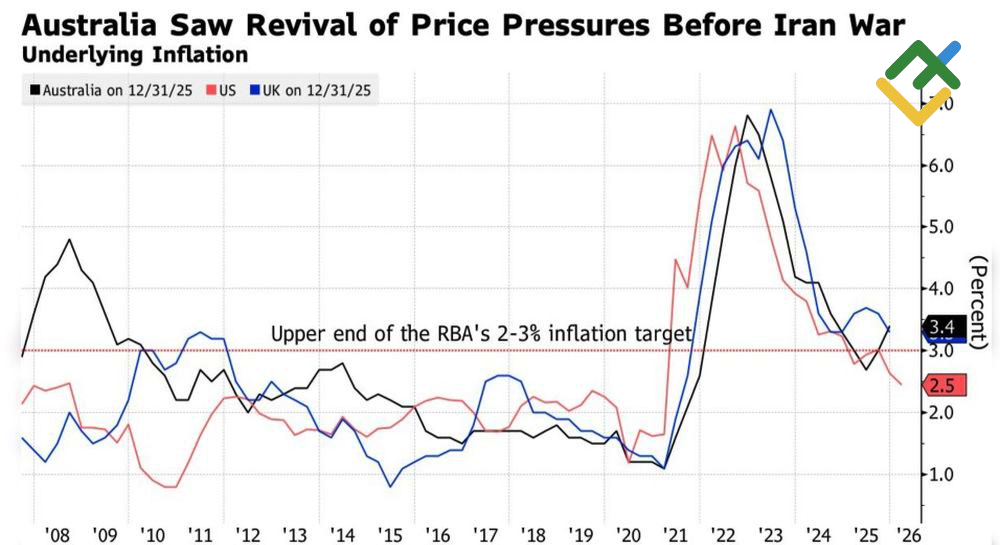
Inflation in Australia and Other Countries
 Source: Bloomberg.
Minutes of the RBA’s latest meeting highlighted concerns that inflation may remain above the upper end of the 2–3% target range, as Middle East tensions push oil prices higher. The central bank also signaled inflation could reach 5% by the end of the second quarter. Deputy Governor Chris Kent said such an outcome would likely require further policy tightening.
Derivatives markets expected the RBA to deliver three more rate hikes, taking the cash rate to 4.85%, its highest level since the 2008 global financial crisis, and potentially above those of other G10 central banks. This outlook boosted confidence in the Australian dollar. What was missing was a catalyst, which came in the form of news of US-Iran negotiations, triggering a surge in AUD/USD.
Central Banks' Interest Rates
Source: Bloomberg.
Minutes of the RBA’s latest meeting highlighted concerns that inflation may remain above the upper end of the 2–3% target range, as Middle East tensions push oil prices higher. The central bank also signaled inflation could reach 5% by the end of the second quarter. Deputy Governor Chris Kent said such an outcome would likely require further policy tightening.
Derivatives markets expected the RBA to deliver three more rate hikes, taking the cash rate to 4.85%, its highest level since the 2008 global financial crisis, and potentially above those of other G10 central banks. This outlook boosted confidence in the Australian dollar. What was missing was a catalyst, which came in the form of news of US-Iran negotiations, triggering a surge in AUD/USD.
Central Banks' Interest Rates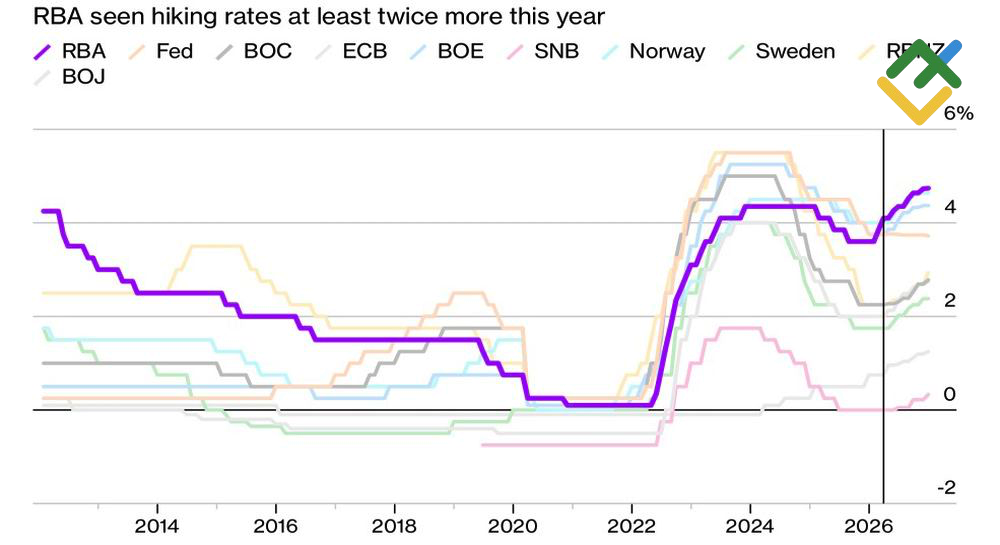 Source: Bloomberg.
Easing Middle East tensions and lower oil prices are reducing the risk of runaway inflation, raising doubts about whether the RBA needs to lift rates to 4.85%. Other central banks may also face less pressure to tighten. For example, expectations for Fed rate cuts in 2026 have surged, with implied odds rising from 12% to 44% following news of a two-week US-Iran ceasefire. In this environment, monetary policy divergence is likely to support AUD/USD, as it did earlier this year.
The Australian dollar is highly sensitive to US stock market performance because of Australia’s relatively high interest rates. It is also responsive to the yuan due to strong trade ties with China. With signs of de-escalation in the Middle East, both the S&P 500 and the renminbi are likely to benefit, bolstering AUD/USD.
Weekly AUDUSD Trading Plan
US-Iran negotiations are unlikely to be smooth, given the gap between the two sides. This could make any gains in the AUD/USD pair uneven. Nevertheless, a peace deal would allow the pair to resume its upward trend. Thus, consider buying the asset once it settles above 0.705.
This forecast is based on the analysis of fundamental factors, including official statements from financial institutions and regulators, various geopolitical and economic developments, and statistical data. Historical market data are also considered.
Source: Bloomberg.
Easing Middle East tensions and lower oil prices are reducing the risk of runaway inflation, raising doubts about whether the RBA needs to lift rates to 4.85%. Other central banks may also face less pressure to tighten. For example, expectations for Fed rate cuts in 2026 have surged, with implied odds rising from 12% to 44% following news of a two-week US-Iran ceasefire. In this environment, monetary policy divergence is likely to support AUD/USD, as it did earlier this year.
The Australian dollar is highly sensitive to US stock market performance because of Australia’s relatively high interest rates. It is also responsive to the yuan due to strong trade ties with China. With signs of de-escalation in the Middle East, both the S&P 500 and the renminbi are likely to benefit, bolstering AUD/USD.
Weekly AUDUSD Trading Plan
US-Iran negotiations are unlikely to be smooth, given the gap between the two sides. This could make any gains in the AUD/USD pair uneven. Nevertheless, a peace deal would allow the pair to resume its upward trend. Thus, consider buying the asset once it settles above 0.705.
This forecast is based on the analysis of fundamental factors, including official statements from financial institutions and regulators, various geopolitical and economic developments, and statistical data. Historical market data are also considered.Publication date:
2026-04-08 11:22:24 (GMT)

